
Key Factors to Consider When Buying a Brush Cutter
Thick underbrush or light weeds? Here are the key factors to look at before buying a brush cutter: the work you need to do, engine type, handlebar comfort and easy maintenance.
5 min read

Are you searching for a reliable brush cutter to manage your landscape? Well, you've arrived at the right place. We at RichardF-Garden understand that every property has its own terrain and its own challenges, from overgrown ditches and fence lines to steep banks and rough corners the lawn mower can't reach. Therefore, we can guide you through the selection process, ensuring you choose the right machine for your budget and unique requirements. Buying a brush cutter is much easier when you know what to look for. Let's get you started!
Understanding Your Landscape Needs
The first step in selecting a brush cutter is understanding your specific landscaping needs. Are you contending with thick underbrush or lighter grass and weeds? Consider what types of vegetation you'll be handling most often in your yard, and how much ground you need to cover.
A brush cutter suited for dense foliage will have more power and robust blades compared to one designed for lighter tasks. For tall grass, weeds and edges, a trimmer head with nylon line is usually all you need, and it's forgiving around fences, trees and garden beds. For woody brush, brambles and young saplings, you'll want a machine strong enough to drive a metal blade, plus a harness to carry the weight comfortably.
Take a moment to walk your property and note:
- the type of growth: grass and weeds, thick brush or small trees;
- the size of the area to clear, and how often you'll do it;
- the terrain: flat lawn, slopes, ditches or rocky ground;
- obstacles such as fences, walls, trees and flower beds.
This simple checklist tells you how much power you really need. It keeps you from paying for more machine than your yard requires, or from struggling with one that's too light for the job.
Engine Power and Type
Engine power is another critical factor. A stronger engine keeps the cutting head turning in thick, tough growth, while a smaller one is lighter and easier to handle for routine trimming. Match the power to the work you identified in the first step.
Two-stroke engines are generally lighter and provide more power instantly, making them ideal for heavy-duty clearing jobs. They run on a mix of gasoline and two-stroke oil, and their simple design keeps them easy to carry for hours. On the other hand, four-stroke engines are known for running quieter and being more fuel-efficient, but may weigh more. Their steady torque and lower emissions make them pleasant to use during long sessions.
Some engines bring together the best of both. The STIHL FS 91 R uses STIHL's 4-MIX four-stroke engine, which delivers steady torque with lower emissions and reduced fuel consumption than comparable two-stroke units. It runs on the same fuel mix as a two-stroke, so there's no separate engine oil to change, and its 710 mL fuel tank extends run time on larger properties. Consider which suits your maintenance style better when shopping: a two-stroke for raw power and light weight, or a four-stroke for quieter, more economical work.
Handlebar Design and Comfort
Ergonomics plays a significant role when using lawn equipment over extended periods. Different handlebar designs, such as loop or bicycle types, can dramatically affect comfort levels during use.
A loop handle is compact and lets you move freely around obstacles, which makes it ideal for trimming along fences, walls and flower beds, or working in tight spaces. A bicycle handle, with two grips set wide apart, lets you sweep the cutting head from side to side in long, even strokes. Paired with a shoulder harness, it's the most comfortable choice for clearing large areas of thick growth. The STIHL FS 360 C-EM, for example, combines a bike handle with a tool-free adjustment, so each user can set the grip just right in seconds.
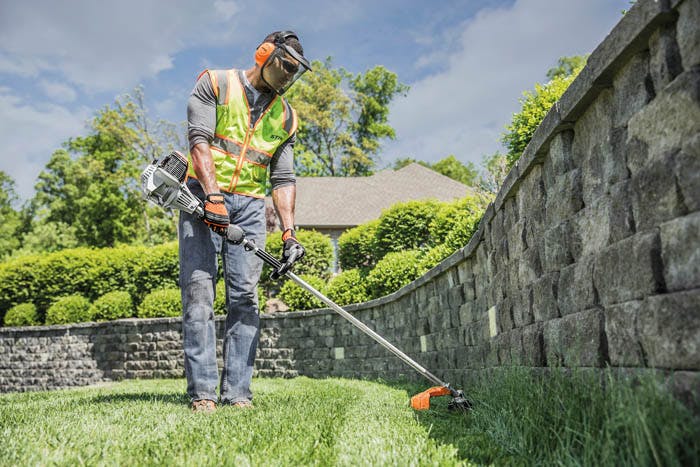
Evaluate which style feels most comfortable and provides optimal control for cutting various angles in your yard. Weight and balance matter too: a well-balanced machine with a good harness feels much lighter at the end of the day than the number on the spec sheet suggests.
Ease of Maintenance
A good brush cutter should not only perform well but also be easy to maintain. Look for models that offer easy access to engine parts for quick servicing, such as an air filter cover you can open in seconds, an accessible spark plug and a simple way to change the cutting line or blade.
Some units come with features that simplify routine maintenance tasks, such as air filter cleaning and blade replacement, ensuring your equipment remains dependable over time. Long-life air filters stretch out the time between cleanings, and automatic engine management, like STIHL's M-Tronic, adjusts the engine settings on its own for altitude, fuel quality and air filter condition.
A few good habits will also keep your brush cutter running for years: clean the air filter regularly, use fresh fuel mixed at the right ratio, keep blades sharp and check them for cracks, and store the machine clean and dry at the end of the season.
For those seeking expert advice on selecting the perfect brush cutter, visit our online store, RichardF-Garden, and browse our full range of trimmers and brush cutters. Our dedicated team is eager to assist you in finding equipment that meets your unique landscaping challenges while providing top-tier performance. We are excited to help you find the ideal brush cutter, so swing by today!