
Get Your Yard Ready for a Canadian Winter: Snow, Trees and Outdoor Equipment
Snow blowers, firewood, hedges, branches, mowers and the BBQ: the questions Canadians ask before winter, answered one by one, with a simple checklist to get your yard ready in time.
18 min read
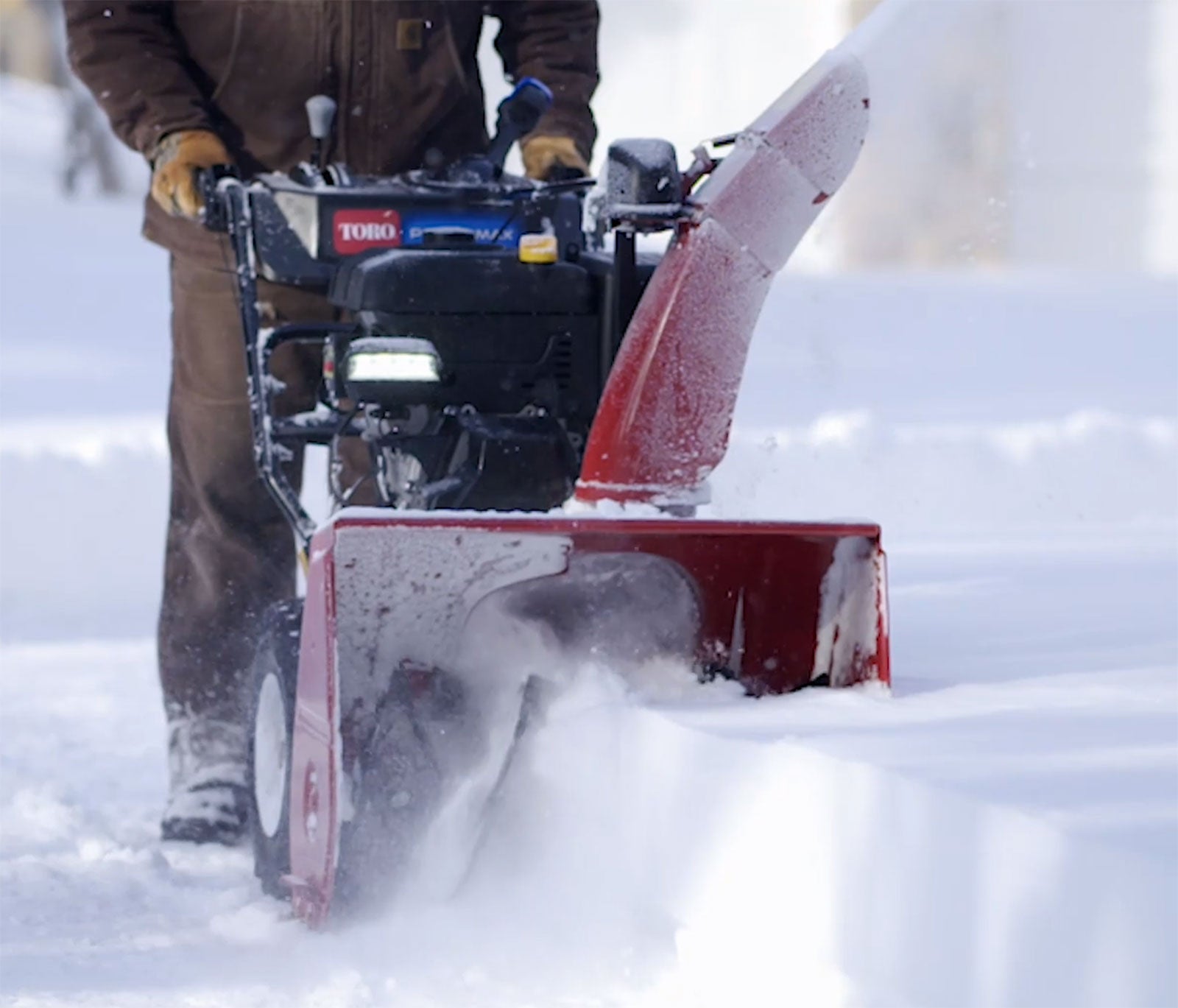
Winter in Canada doesn't wait until you're ready. One weekend you're raking leaves, the next you're digging out the driveway, cutting up a branch the ice brought down and wondering whether you emptied the mower's gas tank. Getting your yard ready for a Canadian winter comes down to a handful of jobs done at the right time.
This guide answers the questions homeowners ask most often before the cold sets in: which snow blower and what size, which chainsaw for firewood and storm cleanup, how to clear overgrown land, protect hedges, deal with branches and leaves, store your mowers and keep grilling all winter. Each answer comes first, followed by practical tips and the equipment from our catalogue that fits the job.
Which Snow Blower Is Best for a Canadian Winter?
For most Canadian homes, the best all-round choice is a two-stage gas snow blower about 24 to 26 inches wide. It handles deep snowfalls, the heavy plow ridge at the end of the driveway and very cold mornings. Single-stage models suit small paved driveways with lighter snow, while long or rural driveways call for 28 to 32 inches.
A two-stage machine uses an auger to gather the snow and a separate impeller to throw it, so it keeps working in deep, packed or wet snow. A single-stage machine uses one fast-spinning auger that touches the ground, which makes it lighter and easier to store, but best kept for paved surfaces and moderate snowfalls.
For a typical two-car driveway, the Toro Power Max 826 OAE is a good example of the category: 26-inch clearing width, 252cc engine, 20-inch intake height for the plow ridge, throws snow up to 45 ft, electric start and six forward and two reverse speeds.
Want to compare every feature step by step? Our snow blower buying guide explains clearing width, intake height, engines and drive systems in detail.
What Size Snow Blower Do I Need?
Match the clearing width to your driveway. A 21-inch single-stage machine is enough for a short, single-car paved driveway, 24 to 26 inches suits a typical two-car driveway, and 30 to 32 inches saves real time on long or rural driveways. If the municipal plow leaves a tall ridge, check the intake height as well.
| Your driveway | Clearing width | Example from our catalogue |
|---|---|---|
| Short, single-car, paved, light to moderate snow | 21 in. single-stage | Toro Power Clear 721 QZE (212cc, electric push-button start, throws up to 35 ft) |
| Two-car driveway, regular heavy snow | 24 to 26 in. two-stage | Toro Power Max 826 OAE (26 in., 20 in. intake, throws up to 45 ft) |
| Long, wide or rural driveway | 30 to 32 in. two-stage | Toro Power Max HD 1232 OHXE (32 in., 375cc, 21.5 in. intake, throws up to 57 ft, power steering) |
Wider is not always better. A bigger machine is heavier to steer and takes more room in the garage: the Power Max HD 1232 OHXE weighs 301 lbs, which is why its power steering makes a real difference on a long driveway. Whatever size you choose, start and run it outdoors only. Health Canada warns never to run gas-powered equipment such as snowblowers, lawnmowers and trimmers in a garage or shed, because of carbon monoxide.
What Is the Best Chainsaw for Cutting Firewood?
For cutting firewood at home, a mid-size gas chainsaw with a 16- to 18-inch bar is the most practical choice. It has the power for hardwood rounds while staying light enough for an afternoon of cutting. Pick the 16-inch class for occasional cutting and smaller logs, and an 18-inch saw if you cut larger wood every year.
The Canadian Centre for Occupational Health and Safety (CCOHS) puts it simply: the weight, power and bar length of the saw should all suit the job. A saw that is too small for your wood works slowly and tires you out, while one that is too big is heavy to handle for hours.
- Occasional firewood and limbs: the STIHL MS 250 (45.4cc, 16-inch bar, 10.1-lb powerhead) is light and easy to handle for branches and firewood-size logs.
- Larger logs and more wood every year: the STIHL MS 291 (55.5cc, 3.8 hp, 18-inch bar, 12.4 lbs) brings more power and reach for bigger rounds.
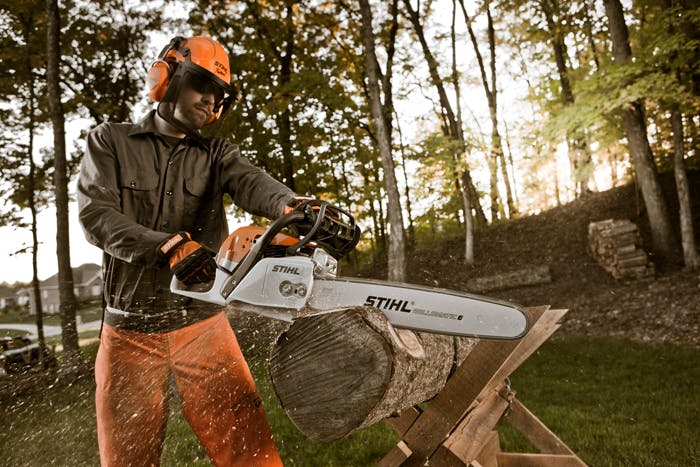
A few habits make firewood cutting safer and faster: cut on a sawhorse rather than on the ground, wear chainsaw protective gear (helmet with face and hearing protection, gloves, protective pants or chaps and sturdy boots), keep the chain sharp and refuel only when the saw is off and cool, at least 3 metres from any source of ignition, as CCOHS recommends. For more on engine size, bar length and safety features, read our tips for buying the right chainsaw.
What Chainsaw Do I Need for Storm Cleanup?
For storm cleanup, you want a saw that starts instantly and is easy to control among tangled branches: a battery chainsaw with a 14- to 16-inch bar handles most fallen limbs. Add a pole pruner for broken branches overhead, and leave anything touching power lines, or large trees resting on buildings, to the utility or a professional.
- The RYOBI 40V HP Brushless 16" Chainsaw Kit comes with a 16-inch bar, a 40V 4Ah battery and a charger, and weighs 12.8 lbs. No fuel to mix and no pull cord: it is ready whenever the storm ends.
- The STIHL HTA 86 telescopic pole pruner (36V AP system, up to 390 cm total length, IPX4 weather resistance) lets you cut hanging or broken branches while standing on the ground. Battery and charger are sold separately.
Storm-damaged wood is unpredictable: bent branches are often under tension and can spring back when cut. Plan each cut, work with someone nearby and watch for power lines, buildings and vehicles around you, as CCOHS advises. If the storm also knocked out the power, see why a backup generator is worth having, and always run a generator outdoors, at least 6 metres (20 feet) from any building, as Health Canada recommends.
What Are the Best Outdoor Power Tools for Clearing Overgrown Land?
To clear overgrown land, you need two tools: a brush cutter for grass, weeds, brambles and saplings, and a chainsaw for trees, limbs and logs. On dense woody brush and small trees, a clearing saw with a circular blade works faster than a brush cutter. With the leaves down, late fall is a good time to see what you cut.
- The STIHL FS 360 C-EM is a professional brushcutter (37.7cc, M-Tronic 3.0 automatic engine adjustment, bike handle) for thick grass, weeds and brush along fences, ditches and trails.
- The STIHL FS 460 C-EM K clearing saw (45.6cc, M-Tronic, 200-22 circular saw blade) is built for heavy brush and small trees.
- For the trees themselves and the fallen wood, a chainsaw like the STIHL MS 291 finishes the job.
Start with a walk around the area: mark stumps, rocks, wire and holes before you cut, since debris thrown by a blade is a real hazard. To choose the right engine size and handle, see our guide to the key factors to consider when buying a brush cutter.
Chainsaw or Brush Cutter: Which One for Property Maintenance?
Use a brush cutter for anything you cut close to the ground: tall grass, weeds, brambles and young saplings along fences, ditches and trails. Use a chainsaw for trees, fallen limbs and firewood. Most rural and acreage properties end up needing both, because each tool is slow or unsafe at the other's job.
| Job | Best tool |
|---|---|
| Tall grass and weeds along fences, ditches and paths | Brush cutter |
| Brambles and thick woody brush | Brush cutter with a metal blade, or a clearing saw |
| Saplings and small trees | Clearing saw |
| Trees, fallen limbs and firewood | Chainsaw |
A brush cutter keeps you upright and works at ground level, where a chainsaw risks hitting the soil and dulling its chain. A chainsaw, on the other hand, is made for wood held off the ground or standing trees, which a brush cutter cannot safely handle.
How Do You Prepare Hedges for Winter?
Prepare hedges in late fall. If the fall was dry, water evergreen hedges deeply before the ground freezes. Remove only dead or broken branches. Tie upright and globe evergreens with twine so heavy snow can't split them, and put up a burlap screen on stakes where road salt or strong winds hit the hedge.
- Hold off on heavy pruning. Pruning in late summer or fall can push tender new growth that doesn't have time to harden before the cold. Keep the shaping for spring and remove only dead, diseased or broken branches now.
- Tie against snow load. Landscape Ontario recommends tying twine at the base of the trunk and spiralling up the plant, gently drawing the branches toward the centre. This is particularly effective for globe cedars, which can split open under snow.
- Screen, don't smother. Pound stakes into the ground before it freezes, then staple burlap to them once the cold settles in, often in November or early December. Wrapping burlap directly on the foliage can cause mould in a mild winter.
- Know which hedges need it most: evergreens planted in the past year, hedges next to heavily salted roads or sidewalks, and those exposed to strong winds.
One more tip: aim your snow blower chute away from the hedge. Snow from the driveway and sidewalk often carries de-icing salt, and salt spray dries out evergreen needles over the winter.
What Is the Best Hedge Trimmer for Seasonal Pruning?
For most home hedges, a cordless hedge trimmer with a 20- to 24-inch blade offers the best balance of power, weight and convenience. Choose a gas trimmer for long hedges and heavy use, and a pole hedge trimmer for tall hedges, so you can reach the top from the ground instead of a ladder.
- Most home hedges: the STIHL HSA 60 Kit has a 24-inch blade and runs on STIHL's AK battery system, with no fuel and low noise for residential streets.
- Long hedges and overgrown growth: the STIHL HS 82R (22.7cc, 24-inch double-sided blade) is designed for thinning and rejuvenation pruning of thick, older growth.
- Tall hedges: the Milwaukee M18 FUEL Pole Articulating Hedge Trimmer Kit has a 24-inch blade with a 1-inch gap and a head that articulates 270 degrees in 12 positions, with an overall length of 87 inches.
Plan the main trims for spring and early summer, once the new growth has come in. With cedars, avoid cutting back into bare brown wood: they rarely grow back from it, which is why light, regular trims work better than one hard cut.
What Is the Best Garden Shredder for Branches and Yard Cleanup?
For branches and storm debris, the best garden shredder is a wood chipper sized for your largest branches. The DR Power PRO 475 chips branches up to 4-3/4 inches thick and feeds itself. For leaves and soft debris, a leaf vacuum/mulcher is faster and much lighter. Many yards benefit from one of each.
- The DR Power PRO 475 Self-Feeding Wood Chipper has a 389cc OHV engine (11.7 HP), electric start with manual backup, a 17 x 27-inch hopper and a 50-lb flywheel. Its pin hitch lets you tow it around the property to wherever the branches are.
- The RYOBI 40V Leaf Vacuum/Mulcher Kit has a 16:1 mulching ratio and a metal impeller and weighs 12.7 lbs: about 16 bags of loose leaves become one.
The result is useful, not just tidier: wood chips make mulch for paths and around trees, and shredded leaves break down quickly in the compost or as a cover for garden beds over the winter.
What Can You Put in a Garden Shredder?
A wood chipper takes branches, brush, prunings and hedge trimmings up to its rated diameter, which is 4-3/4 inches on the DR Power PRO 475. Keep out stones, soil, metal, plastic and lumber with nails or paint. Leaves, pine needles and soft garden waste go better through a leaf mulcher than a branch chipper.
- Yes: branches and limbs within the rated diameter, brush, shrub prunings, hedge trimmings, small storm debris.
- No: rocks, roots with soil attached, metal (nails, wire, hardware), plastic, string and treated, painted or nailed lumber.
- Better in a leaf mulcher: dry leaves, pine needles and light garden waste.
Your owner's manual lists exactly what your model accepts and how to clear a jam. Wear eye and hearing protection, feed from the side of the hopper, and never reach into the hopper or the discharge chute while the engine is running.
How Do You Winterize a Lawn Mower?
To winterize a gas lawn mower, clean the deck, change the oil if your manual calls for it and deal with the fuel: Toro recommends emptying the tank of walk-behind mowers, since gasoline degrades over time. Then store the mower covered, in a dry garage or shed. For a battery mower, bring the battery indoors.
- Clean it. Disconnect the spark plug wire (or remove the battery or safety key) first, then scrape the deck and clean the blade. Toro notes that damp clippings, leaf mulch and mud cause rust and are much harder to remove months later.
- Check the oil. Some engines need an oil change before storage, others don't: follow your owner's manual.
- Deal with the fuel. For a walk-behind gas mower, empty the tank. If you run it dry, do it outside, never in the garage.
- Battery mowers: remove the battery and keep it indoors, in a dry place that doesn't freeze, at the charge level your manual recommends.
- Store it right. Use a cover or tarp, keep the mower away from fertilizer and other corrosive products, and park it on a level spot.
Two mowers from our catalogue show both approaches: the Toro 21 in. Recycler Self-Propelled Gas Lawn Mower (140cc engine, 15-gauge steel deck) and the Toro 60V Max 21 in. Super Recycler (7.5Ah battery included, cast aluminum deck), whose SmartStow design lets you store it upright to save floor space. Before next season, review our lawn mower safety tips.
How Do You Store a Riding Lawn Mower for Winter?
Clean the deck, then fill the tank with fresh fuel treated with a stabilizer and run the engine for a few minutes outdoors so it reaches the whole fuel system, as Toro advises for riding mowers. Remove the battery and store it in a cool, dry place, inflate the tires and park the mower on cardboard under a cover.
A full tank limits condensation, and the stabilizer keeps the fuel from spoiling over the winter. Recharge the battery fully before the first start in spring. Parking on cardboard or another insulating layer protects the tires from cold concrete, and checking the pressure now prevents flat spots.
On a lawn tractor like the Cub Cadet XT1 LT42 IntelliPOWER (547cc engine, 42-inch deck, 12V AGM battery), these simple steps make the spring start much easier. If you'd rather start it now and then during the winter instead of removing the battery, always do it outside with the garage door open, never inside.
How Do You Prepare a Robot Mower for Winter?
Before the first hard frost, give the lawn a final cut, then bring the robot mower inside. Clean the blades and underside, charge the battery as your manual specifies and store it in a dry, frost-free place. Depending on the brand, the charging station either comes indoors too or stays outside, unplugged and covered.
- The STIHL iMOW 5 EVO (lawns up to 1,500 m², perimeter and guide wire) is guided by a wire that normally stays in the ground over the winter: note any spots where it could be damaged by snow clearing.
- The Segway Navimow i110 (wire-free, lawns up to 1/4 acre, IP66 water and dust rating) has no boundary wire to worry about. Its IP66 rating protects it from rain and dust while it mows, but like other robot mowers it belongs indoors for the winter.
Spring start-up is then quick: put the station back, plug it in, check the app for updates and let the robot run its first cut once the grass starts growing. For more on how robot mowers fit into a Canadian yard, read our guide to electric robot lawn mowers.
Can You Use a Gas Grill in Winter?
Yes. A gas grill works all winter in Canada as long as it stays outdoors, in open air, away from walls, windows and doors, with the snow cleared around it. Expect a longer preheat and keep the lid closed. Never move it into a garage or enclosed porch to escape the cold: carbon monoxide builds up quickly.
Health Canada is clear on this point: never operate outdoor equipment that uses fuel, charcoal or wood inside a home, garage, shed, camper or tent. A natural gas grill has one big winter advantage: it is connected to your home's gas line, so there is no tank to refill or exchange in the middle of a cold snap.
The Weber Genesis E-325 Natural Gas (3 burners, extra-large sear zone, porcelain-enameled cast iron grates) and the Weber Genesis S-435 Natural Gas (extra-large sear zone, side burner, expandable top grate) are both built for year-round use outdoors. For recipes and cold-weather techniques, read our winter grilling tips, or compare models in our natural gas BBQ guide.
How Do You Protect a Gas Grill From Snow and Cold?
Brush the snow off the lid, side tables and controls before every cook, keep a shovelled path to the grill and check that vents and burner openings aren't blocked by ice. Once the grill has cooled, put on a fitted, breathable cover. Inspect hoses and connections regularly for cracks, leaks or loose fittings.
Health Canada recommends regularly examining propane and natural gas equipment for leaks, cracks, blocked vents and poor gas line connections. Your grill manual explains the soapy-water leak test to do after any hose or connection work. If you grill with propane, keep the cylinder outdoors and upright, never in the house or garage.
What Is the Best Wet and Dry Vacuum for Winter Cleanup?
For winter cleanup, choose a wet/dry vacuum with a large tank, a drain and an automatic shut-off for wet pickup. It handles salty slush in the garage, melted snow at the entrance and water in a basement corner. The Bosch VAC140AH holds 14.5 gallons and shuts off automatically when the water level gets too high.
- The Bosch VAC140AH (14.5 gal, 150 CFM, HEPA filtration capturing 99.97% of particles at 0.3 µm, 38 lb) adds a drain and drain hose for emptying wet waste without lifting the full tank.
- The Bosch VAC090AH (9 gal, same airflow and filtration, 28 lb) is easier to carry from the garage to the basement.
Both are professional HEPA dust extractors with automatic filter cleaning, so the same machine also handles fine dust from winter workshop and renovation projects. For wet pickup, set up the filter as your manual describes and plug into a GFCI-protected outlet. A wet/dry vacuum handles spills and puddles; for a real flood, call a professional.
Your Winter Yard Checklist
Use this checklist to spread the work over late fall and early winter. Store summer equipment once the grass stops growing, protect hedges as the ground starts to freeze and test your snow blower before the first storm. Keep the chainsaw, the grill and the wet/dry vacuum ready for the whole season.
| Job | When | Equipment |
|---|---|---|
| Final mow, clean and store the mowers | After the last cut of the season | Walk-behind, riding and robot mowers |
| Chip branches, mulch leaves | Late fall | Wood chipper, leaf vacuum/mulcher |
| Clear overgrown areas | Late fall, once the leaves are down | Brush cutter, clearing saw, chainsaw |
| Water, tie and screen evergreen hedges | Before the ground freezes; burlap in November or early December | Twine, stakes, burlap |
| Check oil, add fresh fuel and test the snow blower | Before the first snowfall | Snow blower |
| Cut and stack firewood | Fall, and again as needed | Gas chainsaw, sawhorse |
| Clean up after storms | After each storm | Battery chainsaw, pole pruner |
| Grill and clean up slush | All winter | Natural gas grill, wet/dry vacuum |
Frequently Asked Questions
When should I winterize my lawn mower in Canada?
Right after your last cut of the season, once the grass has stopped growing and before the snow arrives. Waiting until spring means the fuel has sat in the mower all winter and the clippings have dried onto the deck. A little time in late fall saves a hard start and a rusty deck next year.
Can I store a gas mower and a snow blower in the same garage?
Yes, as long as you never start or run either one inside. Keep gasoline in approved fuel containers, away from any source of sparks or flame, and store the mower covered and away from fertilizer. Move the snow blower outside before starting it, even with the garage door open.
Is a battery chainsaw strong enough for firewood?
For occasional cutting of limbs and smaller logs, yes: a 16-inch battery saw like the RYOBI 40V HP is quick to start and easy to handle. If you cut several cords of hardwood each year or work with large rounds, a gas saw with an 18-inch bar, like the STIHL MS 291, is the better tool.
Do I need to wrap my cedar hedge in burlap?
Not always. Established hedges in a sheltered spot often go through winter without help. A burlap screen on stakes is worth it for hedges planted in the past year, those next to salted roads or sidewalks and those exposed to strong winds. Tying with twine helps any upright or globe cedar carry heavy snow.
A yard that is ready for winter starts in spring without surprises: mowers that start, healthy hedges, firewood stacked and a snow blower that is tested before the first storm. RichardF-Garden ships across Canada, so you can equip your yard now rather than in the middle of a storm. Shop our snow blowers and get ready for winter before it gets here.